Department of War
Autonomous offensive security at the speed of the warfighter.
Industry Solutions
Business reasons and regulatory frameworks driving AEV investments in the Department of War
OUR WHY
Ares for the Department of War
The cyber domain is the one where the adversary attacks every day, not just during conflict.
Salt Typhoon sat inside U.S. telecommunications infrastructure for years. Volt Typhoon pre-positioned across U.S. critical infrastructure for the contingency leadership talks about openly. The Defense Industrial Base is breached at a tempo no human red team can match, and the People's Republic of China, the Russian Federation, the Islamic Republic of Iran, and the DPRK are all now deploying offensive AI against the Department's attack surface — not as a future concern but as the current operating reality. The Cyber Mission Force is exceptional and finite. The Department's attack surface is neither. Every weapons program is now a software program. Every logistics node is an API. Every mission partner environment is a trust boundary an adversary will probe before the first round is fired. The math of human-scale red teaming versus machine-scale offense no longer closes. Ares closes it — autonomously, continuously, and at the operational tempo the warfighter actually requires.
The Threat Surface
The attack surface that grew faster than the force structure built to defend it.
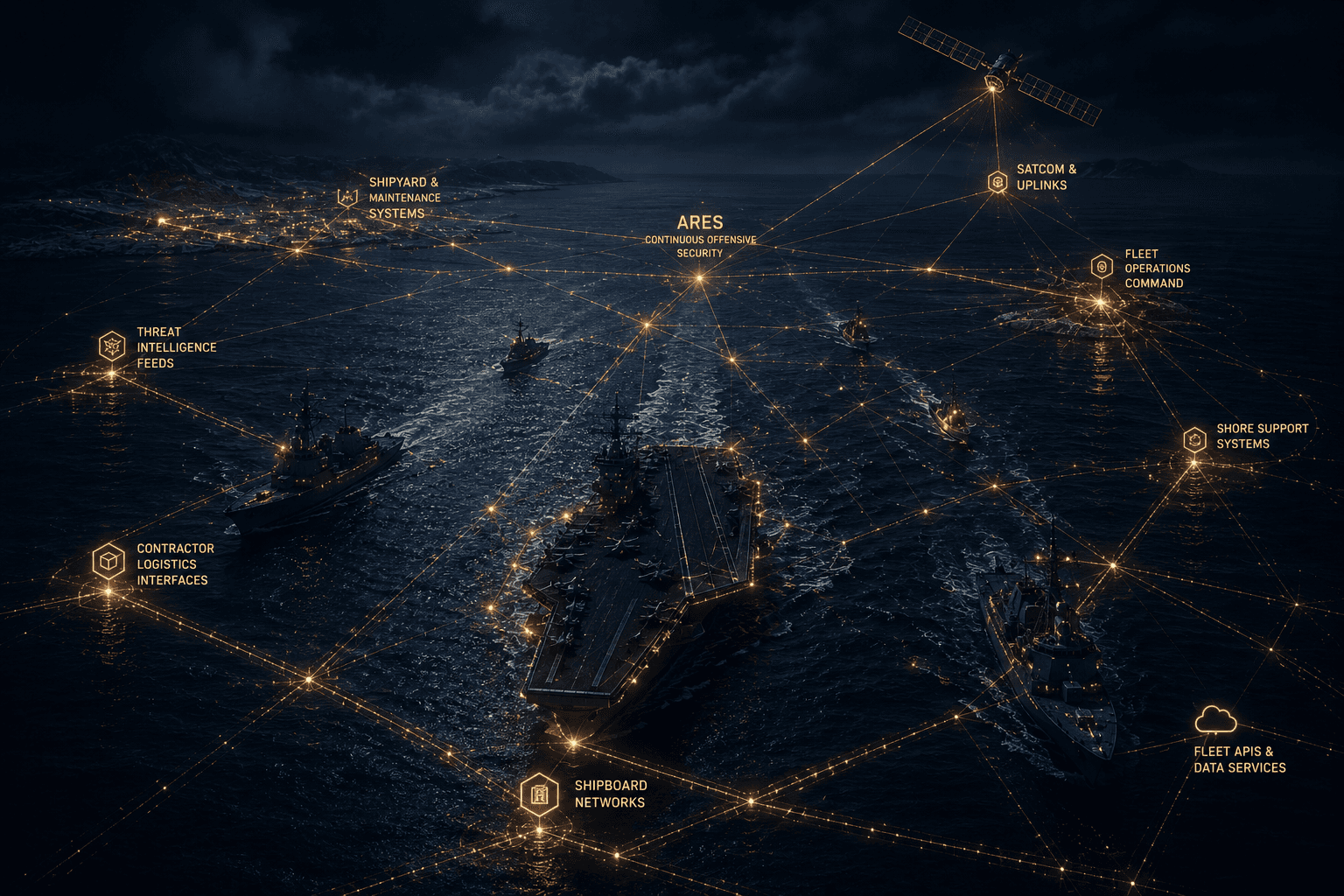
The modern Department runs on software the way it once ran on logistics tonnage, and that software is overwhelmingly API-mediated. Joint All-Domain Command and Control depends on APIs that move targeting and ISR data across services and partners in seconds. Mission command, fires, and C2 platforms expose interfaces every adversary maps before they map the terrain. TRANSCOM, DLA, and the logistics enterprise run on integrations whose compromise degrades force projection without firing a shot. Personnel and identity systems — DEERS, ICAM, the CAC/PIV trust chain — are foundational to every other authorization decision in the enterprise. Weapons platforms are now connected platforms: vehicles, vessels, aircraft, unmanned systems, and the software-defined payloads they carry. Tactical-edge applications and mobile mission apps put the same attack surface in the hand of every operator forward. Mission partner environments and FVEY integrations cross sovereignty and classification boundaries the adversary already understands. JWCC distributes the Department's compute across four hyperscalers, multiplying configuration drift and identity exposure across IL4, IL5, and IL6 enclaves. And underneath all of it, the Defense Industrial Base — the hundreds of thousands of contractors who design, build, and sustain the force — is the soft seam adversaries have been exploiting at industrial scale since well before CMMC 2.0 existed. No human red team scales to that surface. Ares does.
The Ares Platform
Autonomous offensive security, purpose-built for mission tempo.
Ares deploys a coordinated swarm of AI agents against APIs, web applications, and mobile apps — the surface where modern adversaries now operate. Each agent is purpose-built — for reconnaissance, exploit synthesis, kill-chain execution, and validation — and they work together the way a near-peer adversary would. Our API agents enumerate and test the endpoints behind mission systems, logistics, identity, and DIB supplier integrations, including the shadow APIs that microservice architectures and cross-domain integrations generate faster than any inventory can track, with full coverage of the OWASP API Security Top 10 and the chained, multi-stage scenarios that mirror real APT tradecraft — broken authorization on mission data, replay against C2 channels, privilege escalation through federated identity, lateral movement across mission partner trust boundaries. Our web and mobile agents test the operator-facing surface — the portals, the tactical-edge applications, the iOS and Android apps the force actually uses. Ares is designed for the operational realities of the Department: mission-safe execution with surgical precision, severity-tiered findings, operator attribution, and full evidentiary chains suitable for accreditation packages and command-level reporting; deployment paths aligned to IL4, IL5, and IL6 environments and to air-gapped enclaves; and a model architecture compatible with sovereign and on-premises hosting where the mission requires it. The result is force multiplication: the Cyber Mission Force, service red teams, acquisition program offices, and DIB primes operating at the scale of the threat instead of the scale of their headcount.
The Outcomes
Outcomes that matter to the warfighter and to the commands accountable for the mission.
Ares is built to move the metrics that matter to a JFHQ commander, an acquisition program executive, a CISO inside the DIB, and a Cyber Mission Force operator — not the ones that decorate a dashboard. It hardens mission systems against the APT-grade API and business-logic attacks that nation-state adversaries are using right now to pre-position inside the U.S. enterprise. It multiplies the offensive capacity of the Cyber Mission Force and service red teams without expanding the human footprint required to deliver it. It compresses the acquisition red-teaming cycle from milestone-gated assessments to continuous adversarial testing across every release candidate of every program. It hardens the Defense Industrial Base by giving primes and subs an autonomous offensive capability that aligns to CMMC 2.0, NIST 800-171, and the emerging DIB cybersecurity strategy. It produces the audit-grade evidence required for ATO, RMF, and continuous authorization — replacing point-in-time assessments with a defensible, always-on record. And it does it at the operational tempo the Department's stated mission now requires. Ares was built by an operator whose offensive security career began at seventeen inside the U.S. Intelligence Community and at the Pentagon, supporting Marine Corps infrastructure. Her research has been cited in U.S. Congressional proceedings, contributed to the OWASP API Security Top 10 that the Department's own programs now reference, and is the foundation of an active engagement with U.S. Fleet Cyber Command and the Tenth Fleet. When Ares operates against your environment, it operates the way the most patient, most resourced state adversary would. The difference is that this time, the after-action comes to you.
TEAM
Let's Talk
Reach out and one of our team members will respond within 1 business day.